Navigating the US Visa Application Process: A Comprehensive Guidence
Starting a journey to the United States for education, work, or research involves the all-important first step of obtaining the appropriate visa. This process may seem overwhelming due to the many forms, stipulations, and procedures involved. Our guide aims to simplify the US visa application process by providing you with practical advice to help you proceed with confidence.
Understanding the Fundamentals of US Visa Applications
A crucial part of the US visa application procedure is knowing where you need to apply. Typically, applicants are required to submit their visa requests in their home country or current residence. This rule, established by the Department of State, helps maintain an organized process. Applying outside your home country is generally possible only if a US Consulate is unavailable there, which rarely happens.
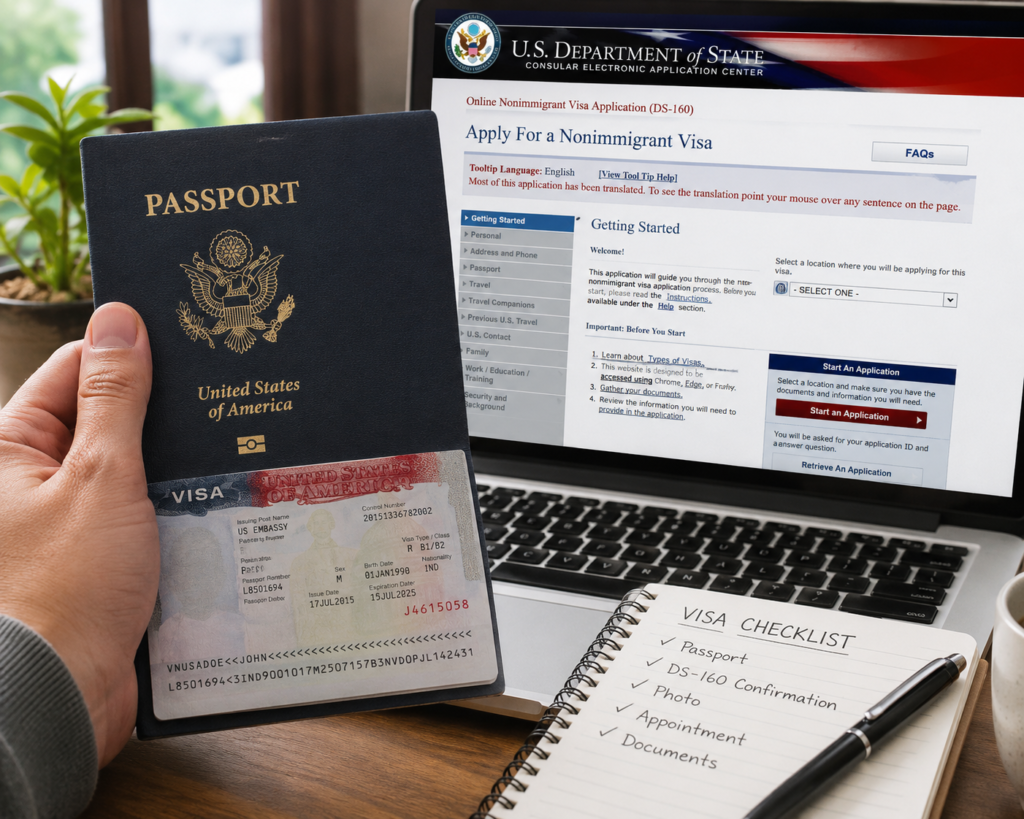
When applying for a nonimmigrant visa, one of the primary requirements is the Form DS-160, the Online Nonimmigrant Visa Application. This comprehensive form collects essential details about your personal background, travel plans, and intentions. Precision and honesty are vital since any discrepancies could cause notable delays or a denial. It’s also necessary to upload a recent digital photograph that complies with the State Department’s specifications.
Tailoring Your DS-160 to Your Visa Type
The DS-160 requires you to specify your trip’s purpose and the visa category you’re applying for. The details you need to provide will differ based on whether you’re applying for a J-1, E-3, H-1B, O-1, or TN visa, among others. For example, J-1 candidates must choose ‘Exchange Visitor (J)’ and specify their status. H-1B applicants should provide the Petition Receipt Number, and remember that the H-1B category doesn’t need Labor Certification. E-3 applicants must select ‘Treaty Trader or Investor (E)’ and ‘Australian in Specialty Occupation (E3),’ including their LCA number. O-1 applicants choose ‘Alien with Extraordinary Ability (O)’ and must supply their Petition Receipt Number, whereas TN applicants select ‘NAFTA Professional (TD/TN)’.
Scheduling and Attending Your Visa Interview
After completing your DS-160, the next logical step is to schedule your visa interview. Securing the earliest available slot that fits your travel schedule is ideal. If there are no suitable dates, book the first available slot and liaise with the Consulate to adjust if possible. You can generally request an expedited appointment only after securing a regular one. It’s important to note that emergency appointments are limited to critical situations impacting US interests or specific educational or research missions.
The visa interview is a pivotal part of the application. Some consulates may require biometric data, such as fingerprints, before, during, or separately from your interview. Each US Consulate lists documents required for the requested visa category, and checking these instructions online is essential. Once your visa is issued and affixed to your passport, arranging for its delivery is necessary, usually taking a few days post-interview. You’ll present this visa for entry into the U.S.
Current Best Practices for a Smooth Application
With the tools available today, the US government scrutinizes applications thoroughly. Hence, your application details must be consistent across all forms and platforms, including your DS-160, social media handles, previous applications, CVs, and supporting documents. Even small discrepancies can lead to additional checks and processing delays. It’s beneficial to keep copies of all previously submitted DS-160 forms and supporting paperwork.
Remaining informed about the latest developments is another best practice. Immigration rules and application processes can change with little notice. Keeping an eye on updates from the Consulate where you intend to apply and the U.S. Department of State’s official communications is crucial. The immigration landscape can be volatile, and staying informed about shifts in travel bans or policy changes for certain nationalities can help avert unnecessary hurdles. This careful attention helps make sure your application remains accurate and complete.
Key Documents for Your Visa Application
Successfully preparing your DS-160 and undergoing your visa interview require several key documents. Your passport should be valid for at least six months beyond your planned duration in the U.S. These arrangements must last throughout your stay. You’ll also need your DS-160 confirmation page and proof of payment for your application fee. While uploading a digital photo is standard, a printed version should be ready in case of technical issues.
Depending on your visa category, additional immigration documents will be necessary. For H-1B and O-1 visas, this includes the Form I-797 Approval Notice and a full copy of your application. J-1 visa seekers must have an updated DS-2019 with a travel endorsement, while Student Interns require a DS-7002 Training Plan. E-3 applicants need a Labor Condition Application and a support letter from their department, whereas TN applicants require a NAFTA memorandum and a professional reference letter. Should you be currently employed, carrying a copy of your employment offer and recent paychecks may also be beneficial.
Navigating Special Circumstances: Administrative Processing and Social Media
Occasionally, a visa decision isn’t immediate, leading to ‘Administrative Processing’ or ‘INA 221(g).’ This phase involves further security checks across several databases. Typically, it can take up to 60 days, but the Department of State advises patience up to 180 days before inquiring. In extreme family emergency situations, earlier inquiries might be possible. During this period, traveling back to the U.S. isn’t viable until clearance is granted. Fields like nuclear physics might experience longer waits due to their sensitive nature. These additional steps are standard procedures to assure national safety.
For H visa candidates, there’s a distinct requirement involving social media. Applicants must make all their social media profiles public, including those used in the past. The government reviews an extensive array of online platforms. Non-compliance can lead to visa refusal. Being open about your online presence is thus vital in the H visa request process.
Individuals engaged in technology-driven areas, such as advanced research or engineering, might face extra scrutiny, which sometimes triggers a process known as ‘Administrative Processing.’ Although it might extend the visa issuance timeline, this step is crucial for national security. Maintaining patience and cooperation during this stage is essential. If uncertainties arise regarding any visa application aspect, seeking advice from your sponsoring institution or an immigration specialist can offer valuable assistance.
Visa Exemptions and Travel Documents
Certain nationalities are exempt from visa requirements when entering the U.S. For example, Canadian citizens traveling with a Canadian passport don’t need a visa, yet must adhere to the entry protocols at arrival. Ensuring all travel documents are properly organized is vital for a hassle-free entry process, even for those exempt from visas. This includes maintaining a passport valid for the entire stay.
Regardless of specific visa needs, understanding your immigration status is critically important. This awareness is particularly relevant for F-1 and J-1 students, who must uphold their legal status by meeting program requirements and securing necessary work or travel permissions. International Scholar Services at your sponsoring institution can provide expert assistance in these matters. For further clarification on various visa categories and compliance, resources pertaining to U.S. government standards and guidelines can offer additional insights.
Final Steps and Admission to the U.S.
After securing your visa and arranging for its delivery, gaining admission into the United States remains the last hurdle. Present your visa to a U.S. Customs and Border Protection (CBP) official at the port of entry, who will evaluate your documents and decide on your entry status. Having all pertinent documents at hand is smart, as they may be requested during the inspection.
Individuals holding an I-797 Approval Notice for H-1B or O-1 visas must remember this document belongs to Purdue University and should be returned to International Scholar Services (ISS) post visa stamping. Retention of I-797 Notices by individuals isn’t allowed. Understanding and following these final instructions ease the transition into a new academic or professional life in the U.S. A meticulous attention to detail is the cornerstone of a successful immigration journey, whether your pursuits involve business visa services or academic ambitions.
Conclusion: Preparedness is Key
The US visa application process, while extensive, is manageable with adequate preparation and meticulous attention to detail. By comprehending the DS-160 requirements, effectively scheduling interviews, adhering to best practices for consistency, staying informed, and gathering all necessary documentation, you significantly improve your chances for success. Remember that resources like your sponsoring institution’s International Scholar Services office exist to support you each step of the way. Engaging proactively in the process ensures a smooth transition to the United States.
Frequently Asked Questions
What is the DS-160 form and how do I complete it?
The DS-160 is the Online Nonimmigrant Visa Application. You’ll need to accurately fill out details about your trip, personal history, and upload a digital photo. Pay close attention to the specific instructions for your visa type, such as J-1, E-3, H-1B, O-1, or TN.
Can I apply for a US visa in a country other than my own?
Generally, you must apply for a US visa in your country of citizenship or your current official residence. Applying in a third country is typically not allowed unless your home country lacks a US Consulate. Check the specific US Department of State announcements for exceptions.
What should I do if my visa application requires administrative processing?
Administrative Processing means a decision cannot be made immediately. This involves security screenings and can take up to 180 days. While waiting, avoid inquiring unless there’s a dire family emergency. You can find more information on the Department of State’s website.
Are there specific requirements for H-1B visa applicants regarding social media?
Yes, H-1B visa applicants must set all social media accounts to public. This includes accounts you may have used in the past, not just current ones. Failure to comply can lead to visa denial.
What are the best practices to ensure my visa application is successful?
Consistency in your application details across all documents and platforms is crucial. Stay updated on current visa policies and procedures, as they can change rapidly. Keeping copies of previous applications and supporting documents will help you maintain accuracy.